Permutation-invariant RMSD (iRMSD)
Comparing structures independently of atom order and molecular symmetry.
Table of contents
- Why a permutation-invariant RMSD?
- Comparing two structures
- Pruning an ensemble
- The standalone
irmsdpackage
Why a permutation-invariant RMSD?
The Cartesian RMSD compares two structures atom by atom, in the order in which the atoms appear in the file. That is a problem whenever chemically identical structures are written down differently:
- the two files use a different atom ordering (a very common situation when structures are passed between different programs),
- symmetry-equivalent atoms are exchanged, e.g. the three hydrogens of a rotating methyl group, or the two oxygens of a carboxylate,
- a structure appears as its mirror image (false enantiomer).
In all of these cases the classical RMSD returns a large value, although the structures are the same. The iRMSD (“permutation-invariant RMSD”) removes this dependency by minimizing not only over the rotation matrix \(\mathbf{U}\), but also over all chemically allowed atom permutations \(\mathbf{P}\):
\[\text{iRMSD}(\mathbf{X},\mathbf{Y}) = \min_{\mathbf{P},\mathbf{U}} \sqrt{\frac{1}{N}\sum_{i}^{N} \left\lVert \mathbf{X}_i - (\mathbf{P}\mathbf{U}\mathbf{Y})_i \right\rVert^2 }\]where \(\mathbf{X}\) and \(\mathbf{Y}\) are the coordinate matrices of the two structures and N is the number of atoms.
CREST assigns canonical atom identities that are independent of the input order, aligns the structures via their rotational axes, and then solves the resulting assignment problem (LSAP) with a Hungarian algorithm. Details of the method are given in
- P. Pracht, Conformational Pruning via the Permutation Invariant Root-Mean-Square Deviation of Atomic Positions, J. Chem. Inf. Model., 2025, 65, 4501–4511.
Comparing two structures
The iRMSD of two structures is calculated with --irmsd <FILE1> <FILE2>, in complete analogy to the classical --rmsd. The example below is taken from the publication: both files contain the same conformer of fluoxetine, but struc2.xyz has a completely scrambled atom order and an additional random rotation applied. The two figures show the identical molecule with the respective atom numbering. The oxygen, for instance, is atom 13 in the first and atom 38 in the second file:
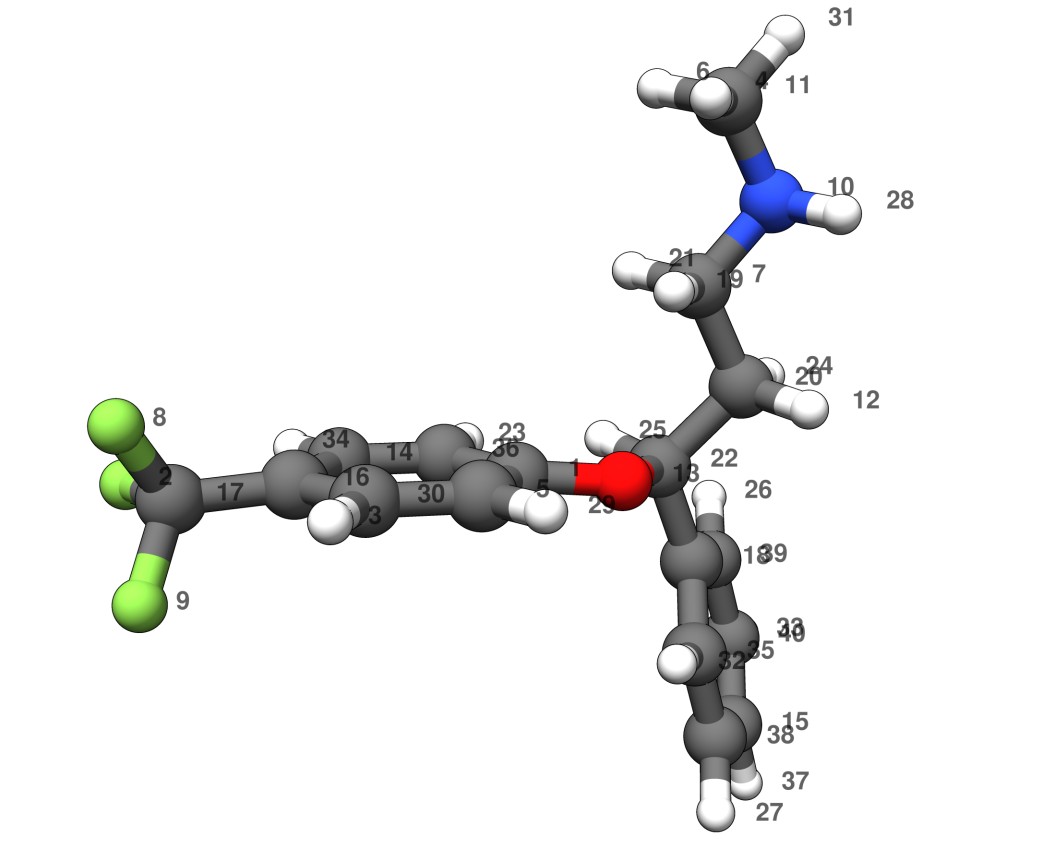
struc1.xyz: fluoxetine with its original atom numbering.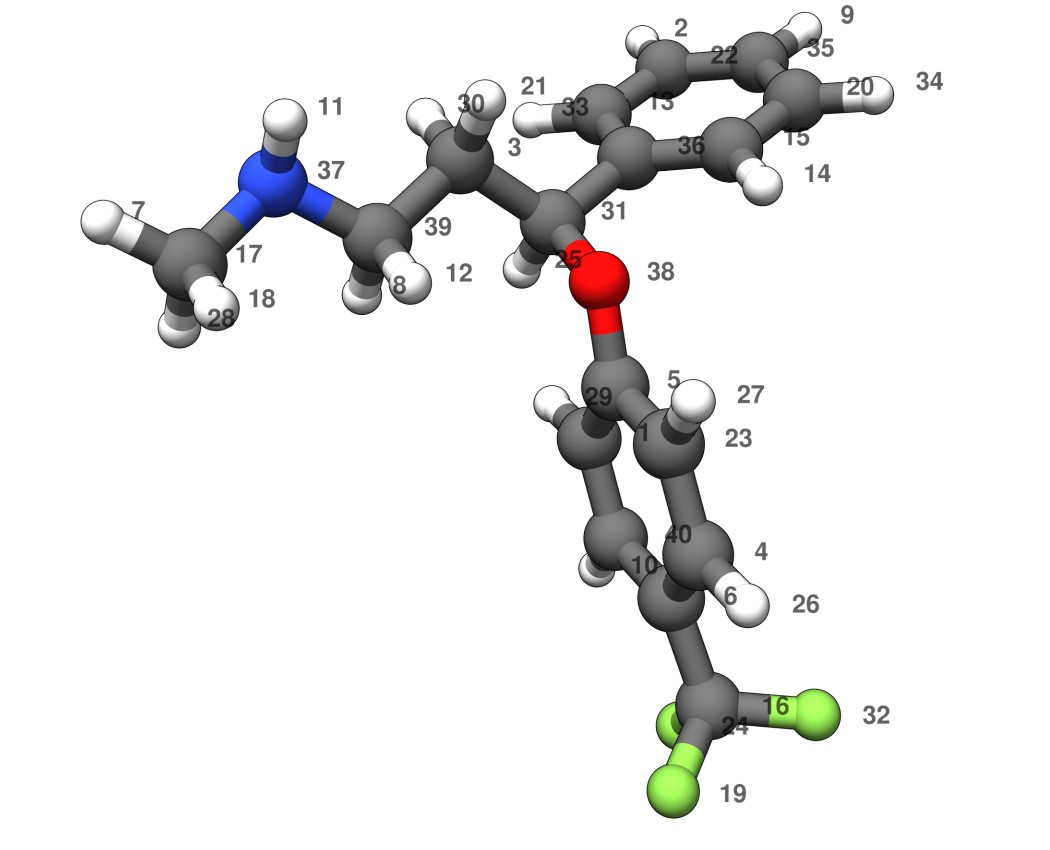
struc2.xyz: the same conformer, rotated and with scrambled atom numbering.crest --irmsd struc1.xyz struc2.xyz
40
fluoxetine
C      -0.0198      0.2158      0.5308
F      -5.0246     -0.2464      0.5593
H      -2.0207      0.0761      3.2888
H       2.0221      5.0303      0.4892
C      -0.4032      0.2003      1.8748
H       1.4542      5.1890     -1.1937
C       2.1773      2.6686     -0.7626
F      -4.6775      0.8294      2.4172
F      -4.3667     -1.3218      2.3289
N       3.0555      3.8290     -0.9233
C       2.3371      5.0467     -0.5601
H       3.7051      1.1947     -0.3434
O       1.3305      0.2076      0.3364
C      -2.3576      0.1386     -0.0950
C       3.3367     -3.7475     -2.0944
C      -2.7426      0.0481      1.2484
C      -4.1855     -0.1659      1.6292
C       2.4651     -1.1750     -1.3319
H       1.7906      2.6512      0.2660
C       2.8963      1.3473     -1.0679
H       1.3203      2.7752     -1.4405
C       1.8806      0.1908     -0.9905
H      -0.7865      0.2662     -1.5101
H       3.3527      1.3925     -2.0651
H       1.1282      0.3962     -1.7541
H       2.8529     -0.6554     -3.3999
H       2.9547     -4.3108     -0.0530
H       3.8626      3.7250     -0.3037
H       0.3581      0.2294      2.6522
C      -1.7511      0.1165      2.2345
H       2.9886      5.9146     -0.7002
H       2.1980     -2.0723      0.6278
H       3.6193     -2.9009     -4.0530
H      -3.1084      0.1174     -0.8845
C       2.5162     -2.2260     -0.4015
C      -1.0075      0.2216     -0.4508
H       3.6502     -4.7430     -2.3936
C       2.9433     -3.5025     -0.7811
C       2.8862     -1.4373     -2.6475
C       3.3158     -2.7117     -3.0256
40
fluoxetine
C      -0.2470     -1.0143     -0.4213
H       0.0828      4.2564     -4.4517
C      -2.1193      2.6178      0.0144
C       1.2089     -1.8204      1.8160
C       0.0619     -0.0804      0.5643
C       0.9632     -2.7436      0.7925
H      -5.9431      1.8117      2.4085
H      -3.2933      0.8099      0.1366
H       2.4555      4.5828     -3.8102
H      -0.0328     -3.0384     -1.1072
H      -3.9856      3.0777      1.8789
H      -2.4640      1.2332      1.6473
C      -0.4255      3.2037     -2.6383
H       1.7581      2.5331     -0.1112
C       1.3640      2.9121     -1.0521
C       1.5502     -4.1306      0.8575
C      -5.0208      1.3357      2.0622
H      -4.4695      0.9920      2.9447
F       1.1253     -4.8340      1.9430
C       2.2338      3.5914     -1.9111
H      -1.7744      3.4140      0.6847
C       0.4427      3.8850     -3.4947
C       0.7599     -0.5019      1.6995
F       1.2525     -4.8990     -0.2270
H      -1.3360      1.0931     -1.2358
H       1.7763     -2.1151      2.6974
H       0.9785      0.2106      2.4926
H      -5.3029      0.4654      1.4587
H      -0.8129     -0.7679     -1.3112
H      -2.6932      3.0927     -0.7916
C      -0.9181      1.8428     -0.5615
F       2.9112     -4.1100      0.9336
H      -1.4519      3.0470     -2.9556
H       3.2752      3.7325     -1.6299
C       1.7755      4.0721     -3.1352
C       0.0230      2.6924     -1.4078
N      -4.2396      2.2887      1.2797
O      -0.2303      1.2522      0.5528
C      -3.0176      1.6462      0.7923
C       0.1996     -2.3349     -0.3081
       ╔════════════════════════════════════════════════╗
       ║                                                ║
       ║     ██████╗██████╗ ███████╗███████╗████████╗   ║
       ║    ██╔════╝██╔══██╗██╔════╝██╔════╝╚══██╔══╝   ║
       ║    ██║     ██████╔╝█████╗  ███████╗   ██║      ║
       ║    ██║     ██╔══██╗██╔══╝  ╚════██║   ██║      ║
       ║    ╚██████╗██║  ██║███████╗███████║   ██║      ║
       ║     ╚═════╝╚═╝  ╚═╝╚══════╝╚══════╝   ╚═╝      ║
       ║                                                ║
       ║    Conformer-Rotamer Ensemble Sampling Tool    ║
       ║            based on the xTB methods            ║
       ║                                                ║
       ╚════════════════════════════════════════════════╝
        Version 3.1.0, Thu, 16 July 12:19:58, 07/16/2026
        commit (97f4fb8) compiled by 'usr@stellaris'

   Cite work conducted with this code as

   • P.Pracht, F.Bohle, S.Grimme, PCCP, 2020, 22, 7169-7192.
   • S.Grimme, JCTC, 2019, 15, 2847-2862.
   • P.Pracht, S.Grimme, C.Bannwarth, F.Bohle, S.Ehlert,
     G.Feldmann, J.Gorges, M.Müller, T.Neudecker, C.Plett,
     S.Spicher, P.Steinbach, P.Wesołowski, F.Zeller,
     J. Chem. Phys., 2024, 160, 114110.

   for works involving QCG cite

   • S.Spicher, C.Plett, P.Pracht, A.Hansen, S.Grimme,
     JCTC, 2022, 18 (5), 3174-3189.
   • C.Plett, S. Grimme,
     Angew. Chem. Int. Ed. 2023, 62, e202214477.

   for works involving MECP screening cite

   • P.Pracht, C.Bannwarth, JCTC, 2022, 18 (10), 6370-6385.

   for works involving the TTConf reimplementaiton cite

   • C.Zurek, et al., JCTC, 2025, 21, 1459-1475.

   Original code
     P.Pracht, S.Grimme, Universität Bonn, MCTC
   with help from (alphabetical order):
     C.Bannwarth, F.Bohle, S.Ehlert, G.Feldmann, J.Gorges,
     S.Grimme, C.Plett, P.Pracht, L.Rindt, S.Spicher,
     P.Steinbach, P.Wesolowski, F.Zeller

   Online documentation is available at
   https://crest-lab.github.io/crest-docs/

   This program is distributed in the hope that it will be useful,
   but WITHOUT ANY WARRANTY; without even the implied warranty of
   MERCHANTABILITY or FITNESS FOR A PARTICULAR PURPOSE. See the
   GNU Lesser General Public License (LGPL) for more details.

 Command line input:
 $ crest --irmsd struc1.xyz struc2.xyz


> All CLI arguments successfully processed.

> Setting up backup calculator ... done.
> Reading files struc1.xyz and struc2.xyz

 iRMSD algorithm
 reference: struc1.xyz
 processed: struc2.xyz

 false enantiomers possible?:  F
 allow inversion?:             T
 using canonical atom identities as rank backend

 aligned structures written to irmsd.xyz

 Calculated iRMSD (Å):      0.00008793
The classical RMSD of these two files is meaningless, while the iRMSD correctly identifies them as the same structure:
| Command | Result |
|---|---|
crest --rmsd struc1.xyz struc2.xyz | Calculated RMSD (Å): 5.13311345 |
crest --irmsd struc1.xyz struc2.xyz | Calculated iRMSD (Å): 0.00008793 |
Besides the printout, the aligned structures are written to irmsd.xyz, with the atoms of the second structure reordered to match the reference. This file can be used directly for a visual overlay of the two geometries.
Handling of mirror images
CREST decides automatically whether a geometry inversion has to be considered, which is printed as false enantiomers possible? at the start of the run. For structures without stereocenters, an inverted copy describes the same molecule and is allowed; for genuine enantiomers it must not be. The automatism can be overruled:
| Command | Description |
|---|---|
--irmsd <FILE1> <FILE2> | iRMSD of two structures, inversion handled automatically |
--irmsd_noinv <FILE1> <FILE2> | never invert, i.e., enantiomers are distinguished |
--inversion <auto\|on\|off> | explicit control of the inversion check, also for the ensemble modes below |
Pruning an ensemble
The same algorithm is available for entire ensembles through the sorting driver, crest --sort <ENSEMBLE> <MODE>. This is the iRMSD counterpart of the classical CREGEN sorting:
| Mode | Description |
|---|---|
isort | assign structures to conformer groups by iRMSD and the RMSD threshold --rthr |
isort_noid | the same, but without canonical atom identities (element types as ranks) |
all, allpair | all unique pair iRMSDs of the ensemble, written to cregen_rmsds.csv |
cregen | the original, empirical CREGEN procedure |
As an example, ensemble.xyz below contains a single conformer of alanineglycine twice. In the second entry only the methyl group is rotated by 120°, which permutes the three methyl hydrogens. Classical RMSD sees a difference of 0.687 Å, far above the default threshold of RTHR = 0.125 Å, and would keep both structures. The iRMSD-based sorting recognizes the rotamer and merges them into one group with degeneracy 2:
crest --sort ensemble.xyz isort
20

C     2.081440     0.615100    -0.508430
C     2.742230     1.824030    -1.200820
N     4.117790     1.799870    -1.190410
C     4.943570     2.827040    -1.822060
C     6.440080     2.569360    -1.637600
O     7.351600     3.252270    -2.069090
N     0.610100     0.695090    -0.538780
O     2.095560     2.724940    -1.739670
O     6.705220     1.463410    -0.897460
H     0.303080     1.426060     0.103770
H     0.338420     1.050680    -1.460480
C     2.488753    -0.593400    -1.198448
H     2.416500     0.557400     0.532050
H     4.614100     1.081980    -0.670550
H     4.699850     3.794460    -1.373720
H     4.722890     2.844690    -2.894180
H     7.687400     1.448620    -0.860340
H     2.029201    -1.457008    -0.719999
H     2.170233    -0.542411    -2.238576
H     3.572730    -0.688405    -1.154998
20

C       2.081440      0.615100     -0.508430
C       2.742230      1.824030     -1.200820
N       4.117790      1.799870     -1.190410
C       4.943570      2.827040     -1.822060
C       6.440080      2.569360     -1.637600
O       7.351600      3.252270     -2.069090
N       0.610100      0.695090     -0.538780
O       2.095560      2.724940     -1.739670
O       6.705220      1.463410     -0.897460
H       0.303080      1.426060      0.103770
H       0.338420      1.050680     -1.460480
C       2.488753     -0.593400     -1.198448
H       2.416500      0.557400      0.532050
H       4.614100      1.081980     -0.670550
H       4.699850      3.794460     -1.373720
H       4.722890      2.844690     -2.894180
H       7.687400      1.448620     -0.860340
H       2.170234     -0.542411     -2.238576
H       3.572730     -0.688405     -1.154997
H       2.029202     -1.457008     -0.719998
       ╔════════════════════════════════════════════════╗
       ║                                                ║
       ║     ██████╗██████╗ ███████╗███████╗████████╗   ║
       ║    ██╔════╝██╔══██╗██╔════╝██╔════╝╚══██╔══╝   ║
       ║    ██║     ██████╔╝█████╗  ███████╗   ██║      ║
       ║    ██║     ██╔══██╗██╔══╝  ╚════██║   ██║      ║
       ║    ╚██████╗██║  ██║███████╗███████║   ██║      ║
       ║     ╚═════╝╚═╝  ╚═╝╚══════╝╚══════╝   ╚═╝      ║
       ║                                                ║
       ║    Conformer-Rotamer Ensemble Sampling Tool    ║
       ║            based on the xTB methods            ║
       ║                                                ║
       ╚════════════════════════════════════════════════╝
        Version 3.1.0, Thu, 16 July 12:19:58, 07/16/2026
        commit (97f4fb8) compiled by 'usr@stellaris'

   Cite work conducted with this code as

   • P.Pracht, F.Bohle, S.Grimme, PCCP, 2020, 22, 7169-7192.
   • S.Grimme, JCTC, 2019, 15, 2847-2862.
   • P.Pracht, S.Grimme, C.Bannwarth, F.Bohle, S.Ehlert,
     G.Feldmann, J.Gorges, M.Müller, T.Neudecker, C.Plett,
     S.Spicher, P.Steinbach, P.Wesołowski, F.Zeller,
     J. Chem. Phys., 2024, 160, 114110.

   for works involving QCG cite

   • S.Spicher, C.Plett, P.Pracht, A.Hansen, S.Grimme,
     JCTC, 2022, 18 (5), 3174-3189.
   • C.Plett, S. Grimme,
     Angew. Chem. Int. Ed. 2023, 62, e202214477.

   for works involving MECP screening cite

   • P.Pracht, C.Bannwarth, JCTC, 2022, 18 (10), 6370-6385.

   for works involving the TTConf reimplementaiton cite

   • C.Zurek, et al., JCTC, 2025, 21, 1459-1475.

   Original code
     P.Pracht, S.Grimme, Universität Bonn, MCTC
   with help from (alphabetical order):
     C.Bannwarth, F.Bohle, S.Ehlert, G.Feldmann, J.Gorges,
     S.Grimme, C.Plett, P.Pracht, L.Rindt, S.Spicher,
     P.Steinbach, P.Wesolowski, F.Zeller

   Online documentation is available at
   https://crest-lab.github.io/crest-docs/

   This program is distributed in the hope that it will be useful,
   but WITHOUT ANY WARRANTY; without even the implied warranty of
   MERCHANTABILITY or FITNESS FOR A PARTICULAR PURPOSE. See the
   GNU Lesser General Public License (LGPL) for more details.

 Command line input:
 $ crest --sort ens2.xyz isort


> All CLI arguments successfully processed.

> Setting up backup calculator ... done.
> Read ensemble ens2.xyz ... 2 structures!

 Assigning conformers based on iRMSD and RTHR
 --------------------------------------------
CREGEN> Info for iRMSD sorting:
  number of structures         :         2
  RTHR (RMSD threshold)        :   0.12500 Å
  ETHR (energy threshold)      :  7.97E-05 Ha
  OpenMP threads               :         8
  Individual atom IDs?         :     false
  False rotamer check?         :      auto

CREGEN> Sorting ensemble by energy ... done.
CREGEN> Setting up canonical atom ranks ... done.
 * wall-time:     0 d,  0 h,  0 min,  0.001 sec
 *  cpu-time:     0 d,  0 h,  0 min,  0.003 sec
 * ratio c/w:     4.731 speedup
 * Corresponding to approximately .275 ms per processed RMSD

CREGEN> Check for false rotamers (geometry inversion)? --> F
CREGEN> Allocating iRMSD work cache ... done.

CREGEN> Running all-pair iRMSDs ... done.
 * wall-time:     0 d,  0 h,  0 min,  0.000 sec
 *  cpu-time:     0 d,  0 h,  0 min,  0.000 sec
 * ratio c/w:     4.964 speedup

********************************************************************************
               ΔE             Etot   weight  conf.weight conformer
     id  kcal/mol          hartree     p(i)     p(group)     group degen origin
    ---- -------- ---------------- -------- ------------ --------- ----- ------
       1   0.0000         0.000000  0.50000      1.00000         1     2
       2   0.0000         0.000000  0.50000            .         .     .
********************************************************************************
Statistics for *THIS* ensemble:
-----------------------------------
 Number of groups & total                :  1, 2
 Temperature used for populations        :     298.15 K
 Energy of lowest structure              :    0.000000E+00
 Ensemble average energy (kcal/mol)      :      0.00000000
 Ensemble entropy (J/mol K, cal/mol K)   :      5.763    1.377
 Ensemble free energy (kcal/mol)         :     -0.41068161
 Population of lowest strucure           :    100.000 %
 Highest population & group              :    100.000 %, 1
 Accum.population of lowest 10 groups    :    100.000 %
 50% accum.population for groups         :      1 - 1
 95% accum.population for groups         :      1 - 1
********************************************************************************
Number of unique conformers for further calculation: 1
List of relative energies (kcal/mol) saved as "crest.energies"
Unique-structure file written to: crest_ensemble.xyz


  Important files written by CREST during this run
 ------------------------------------------------------------------------
 crest_conformers.xyz        │ unique conformers (1 per rotamer group), energy-sorted
 crest_rotamers.xyz          │ all structures including rotamers
 crest_best.xyz              │ lowest-energy structure
 cregen.full                 │ full CREGEN output (written when terminal output is abbreviated)
 ------------------------------------------------------------------------

 -----------------
 Wall Time Summary
 -----------------
 CREST runtime (total)               0 d,  0 h,  0 min,  0.025 sec
 ------------------------------------------------------------------
 Sorting                    ...        0 min,  0.001 sec (  4.226%)
 I/O and setup              ...        0 min,  0.024 sec ( 95.774%)
 ------------------------------------------------------------------
 * wall-time:     0 d,  0 h,  0 min,  0.025 sec
 *  cpu-time:     0 d,  0 h,  0 min,  0.104 sec
 * ratio c/w:     4.169 speedup
 ------------------------------------------------------------------
 * Peak RSS:     9.89 MiB
 CREST terminated normally.
The resulting files are the usual CREGEN output: crest_conformers.xyz (one structure per group), crest_rotamers.xyz (all structures), and crest.energies.
The standalone irmsd package
The algorithm is also available independently of CREST as a Python package with a Fortran backend, irmsd . It is the reference implementation for the publication above and is convenient whenever structures should be compared or pruned outside of a CREST workflow. The fluoxetine figures shown above are taken from its repository.
pip install irmsdThe package ships a command line tool with three subcommands:
| Subcommand | Purpose |
|---|---|
irmsd prop | structural properties (coordination numbers, rotational constants, canonical identifiers) |
irmsd compare | iRMSD of two structures (--quaternion for the classical RMSD, --inversion, --heavy) |
irmsd sort, irmsd prune | pruning/clustering of an ensemble (--rthr, --ethr, --ewin, --classic) |
The same functionality is accessible from Python, which makes it easy to embed the pruning into an own workflow:
from irmsd import read_structures, sorter_irmsd_molecule, prune

# read an xyz file with multiple frames
molecules = read_structures('/PATH/TO/YOUR/input.xyz')

# assign molecules to groups and get the aligned structures
groups, aligned_molecules = sorter_irmsd_molecule(molecules, rthr=0.125)

# ... or directly generate the pruned conformer list
pruned_molecules = prune(molecules, rthr=0.125)